
Home › What we build › Mobile CT, PET/CT and MRI units
What we build · Health
Mobile CT, PET/CT and MRI units
A mobile CT, PET/CT or MRI unit is built around a scanner that weighs thousands of pounds, needs its own power, cooling and shielding, and has to arrive at every site still aligned. High Level Enterprises builds mobile imaging units on medium-duty chassis and trailers for hospitals, imaging providers and health systems that take scanning to rural and underserved communities. HLE engineering has drawn CT units on International chassis, including a tag-axle International HV607, a 34-foot mobile CT trailer and a mobile MRI trailer. See also mobile imaging units, where HLE’s delivered mammography units are.
Start from a plan
Proven layouts to start from
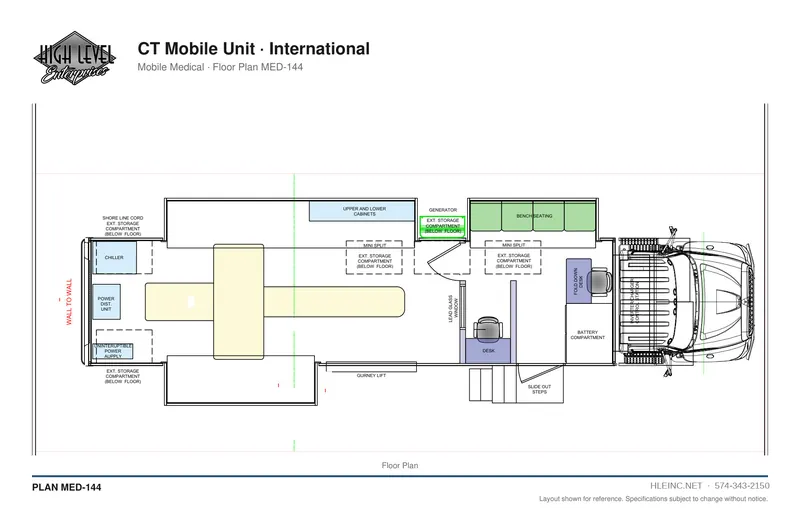
CT Mobile Unit
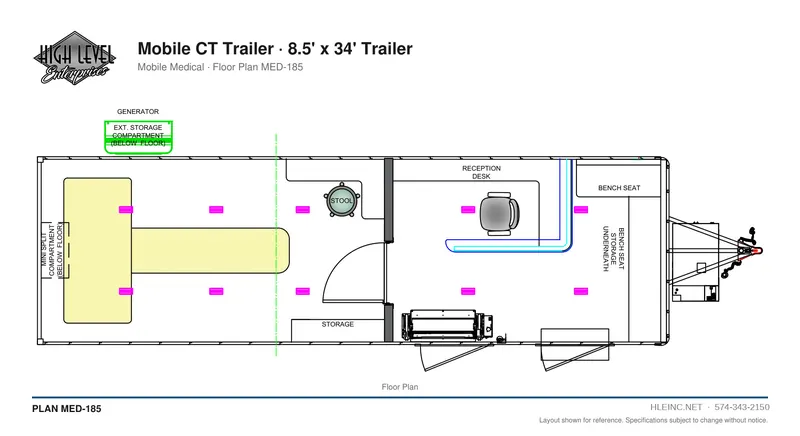
Mobile CT Trailer
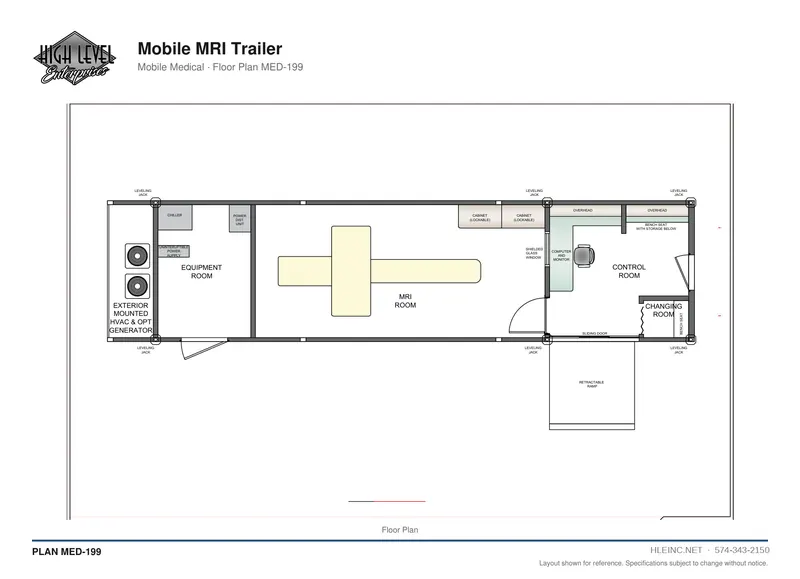
Mobile MRI Trailer
Three of the plans drawn for this vehicle type. Every plan can be built as drawn or used as the starting point.
Who buys a mobile CT or MRI unit
- Hospitals and health systems — scanning at rural clinics and partner sites that cannot justify a fixed scanner.
- Imaging providers — shared-service units that rotate between sites on a schedule.
- Cancer and lung-screening programs — low-dose CT screening where the patients are.
- Interim capacity — a unit on site while a fixed suite is replaced or renovated.
What HLE builds into a mobile imaging unit
- The scanner room — floor structure, mounting and leveling to the scanner maker’s site-planning guide; shielding designed with the vendor’s physicist.
- Power and cooling — generator and shore power sized for the scanner, chiller and HVAC for the gantry and electronics.
- Patient areas — control room with a view window, changing and prep space, wheelchair lift.
- On the road — stabilizing jacks and leveling, and a body that holds the scanner’s alignment between sites.
Platforms
International medium-duty chassis, including tag-axle configurations for heavier scanners, and HLE-built trailers to 34 feet and beyond. Floor plans you can start from are below.
How this unit is built
The construction column for a mobile CT or MRI unit
What HLE does, and what to ask any builder before you compare quotes. The full column is on How we build it.
What HLE builds
One-piece pressure-laminated sidewalls with no horizontal seam. Windows cut from the panel.
What to check on any proposal
How many pieces is the sidewall, and where do the seams fall? Every seam is a future leak.
What HLE builds
Resin-infused composite subfloor over the cage; it sheds water instead of absorbing it. Seamless medical-grade sheet vinyl coved up the wall where the use calls for it.
What to check on any proposal
What is under the vinyl? A plywood subfloor goes soft after one winter of mopping.
What HLE builds
Solid hardwood cabinetry with stainless hardware. PerformMAX 500 resin-infused panel in wet areas, not plywood, with sealed edges. No particleboard anywhere a sink, a fridge or a mop can reach.
What to check on any proposal
Ask for the substrate by name. "Cabinets" on a spec sheet can mean particleboard that swells and fails in two to four years.
What HLE builds
Harnesses built in HLE's own shop with marine-grade connectors, every circuit labeled at both ends, a panel drawing delivered with the unit.
What to check on any proposal
Ask for the panel drawing before delivery. If they cannot produce one, the next technician cannot either.
Common questions
What program directors ask first
Which scanner can go in the unit?
The one your program buys. HLE builds to the scanner maker’s site-planning guide and works with the vendor on shielding, power and installation.
Truck or trailer?
A truck moves between sites with one driver. A trailer gives more length for a larger scanner and can stay on a site while the tractor leaves. We will lay out both.
Who installs the scanner?
The scanner maker installs and calibrates it. HLE builds the room, the power and the cooling it needs and coordinates the installation schedule.
Request a proposal
Tell us the vehicle. We tell you what it costs and what to attach.
Pick a plan or describe the program. Say whether you need a price, a bid package, a grant kit or a formal proposal. A person at HLE reads every request; nothing goes to a queue.
Or call 574-343-2150, 7:30 to 4:30 Eastern, and ask for Tabatha.